


Professional Speaker
-
![SD-36 SD-64 Active Powered Bluetooth Wireless Portable Line Array Column Speaker]() SD-36 SD-64 Active Powered Bluetooth Wireless Portable Li...1. Powerful and Stability:This Multi function portable sound system uses 1pcs subwoofer and 1pcs column array speaker, adopts class-D amplifier, with 1200 watts rated power and MAX 3600 Watts...read more
SD-36 SD-64 Active Powered Bluetooth Wireless Portable Li...1. Powerful and Stability:This Multi function portable sound system uses 1pcs subwoofer and 1pcs column array speaker, adopts class-D amplifier, with 1200 watts rated power and MAX 3600 Watts...read more -
![SD-241S SD-441S SD-841S Full-range Column Speaker]() SD-241S SD-441S SD-841S Full-range Column SpeakerSD-241S/SD-441S/SD-841S Full-range column speakerread more
SD-241S SD-441S SD-841S Full-range Column SpeakerSD-241S/SD-441S/SD-841S Full-range column speakerread more -
![12-inch Professional Monitor Loudspeaker SD-112M]() 12-inch Professional Monitor Loudspeaker SD-112MFT series is a professional sound box designed for stage monitoring. The appearance of the sound box is atmospheric, which fully reflects the perfect restoration of music, the clarity and...read more
12-inch Professional Monitor Loudspeaker SD-112MFT series is a professional sound box designed for stage monitoring. The appearance of the sound box is atmospheric, which fully reflects the perfect restoration of music, the clarity and...read more -
![SD-350G SD-550G SD-700G SD-900G Active Speaker System]() SD-350G SD-550G SD-700G SD-900G Active Speaker SystemSD-350G/SD-550G/SD-700G/SD-900Gread more
SD-350G SD-550G SD-700G SD-900G Active Speaker SystemSD-350G/SD-550G/SD-700G/SD-900Gread more
8-inch/10-inch/12-inch/15-inch Active Full-range Speaker -
![SD-16 SD-20 SD-24 Line Array Speakers Active Professional]() SD-16 SD-20 SD-24 Line Array Speakers Active ProfessionalSD-16/SD-20/SD-24 Single 15-inch/single 18-inch/single 18-inch DSP Active Line Array Ultra-low Speakerread more
SD-16 SD-20 SD-24 Line Array Speakers Active ProfessionalSD-16/SD-20/SD-24 Single 15-inch/single 18-inch/single 18-inch DSP Active Line Array Ultra-low Speakerread more -
![SD-8F SD-10F SD-12F SD-15F Two-Way Full-Range Speaker]() SD-8F SD-10F SD-12F SD-15F Two-Way Full-Range SpeakerThe SONBS SD-8F series is a portable two-way speaker system designed for both main sound reinforcement and monitoring applications.These passive speakers are engineered to deliver the sensitivity,...read more
SD-8F SD-10F SD-12F SD-15F Two-Way Full-Range SpeakerThe SONBS SD-8F series is a portable two-way speaker system designed for both main sound reinforcement and monitoring applications.These passive speakers are engineered to deliver the sensitivity,...read more -
![SD-445S SD-645S High End Array Speaker]()
-
![SD-26D SD-46D Powered Line Array Speaker System]()
-
![SD-12Q SD-15Q Long Range Horn Speaker]() SD-12Q SD-15Q Long Range Horn SpeakerTwo-Way Mid-Range Loudspeakerread more
SD-12Q SD-15Q Long Range Horn SpeakerTwo-Way Mid-Range Loudspeakerread more
All-Weather High-Power PA Speaker with Horn-Loaded Design -
![SD-10LA Coaxial Line Array Speaker]() SD-10LA Coaxial Line Array SpeakerSD-10LA 10-inch Coaxial Linear Array Full Frequency Speakerread more
SD-10LA Coaxial Line Array SpeakerSD-10LA 10-inch Coaxial Linear Array Full Frequency Speakerread more -
![SD-265H SD-265HD Two Way Line Array Speaker]() SD-265H SD-265HD Two Way Line Array SpeakerSD-265H Dual 6-inch Two-way Linear Array Speakerread more
SD-265H SD-265HD Two Way Line Array SpeakerSD-265H Dual 6-inch Two-way Linear Array Speakerread more
SD-265HD Single 15-inch Ultra-low Frequency Speaker -
![SD-208H SD-208HD Speaker Line Array]() SD-208H SD-208HD Speaker Line ArraySD-208H Dual 8-inch Two-way Linear Array Speakerread more
SD-208H SD-208HD Speaker Line ArraySD-208H Dual 8-inch Two-way Linear Array Speakerread more
SD-208HD Single 18-inch Ultra-low Frequency Speaker


Why Choose Us
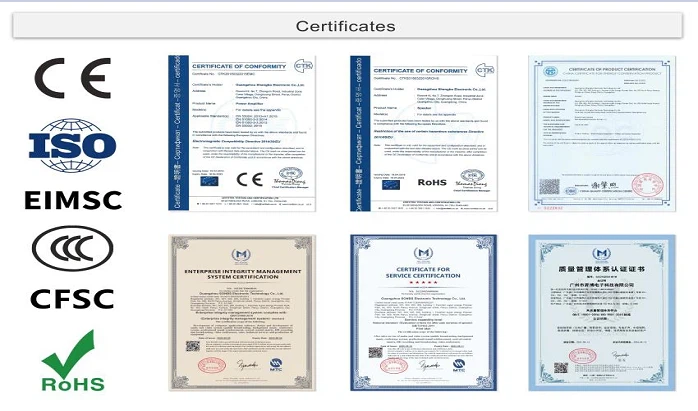
Our Certificate
ISO, CE, ROHS, EIMSC, CCC, CFSC.
Factory strength
SONBS Owns 3 Factories, 1 Marketing Technology Service Center And Over 15 Sub-Office.
Professional Team
Our professional engineer team will help partners to make turn-key solution for projects, improve solution until the customer is satisfied, and answer all technical questions.
Provide technical training
Our professional engineer team can offer technical training and guide the customer to install equipment, for big project, we can send engineer on site to guide the installation.
What is Professional Speaker
Professional speaker are the type of transducers by use electromagnetic waves that convert electromagnetic waves into sound waves. It is used to connect to a computer system which creates a sound that is considered an output part of computer systems. Here the user may give an audio input to the systems which is either in analog or digital form to create analog electromagnetic waves (analog speaker) to give sound waves as an output.
Benefits of Professional Speaker
Excellent sound quality
Professional speakers are an important sound-producing part of the audio system, and their sound quality directly affects the overall effect of the audio system. One of the advantages of speaker speakers is their excellent sound quality, which can accurately restore and deliver recorded sounds to listeners, allowing listeners to better feel the emotions and thoughts conveyed by music, movies, speeches and other content.
Sound spreads over a wide range
Compared with other types of speakers, professional speakers have a wider sound propagation range and can transmit sound to a longer distance to meet the needs of more listeners. In addition, in outdoor environments, the sound transmission effect of horn speakers is also better, and they can adapt to various complex climates and environments.
Easy to install and use
The installation and use of professional speakers are very simple and convenient. You only need to connect them to the sound system, then place the speakers in the appropriate position and you can use them immediately. In addition, the purchase price of horn speakers is relatively low, so they are popular among users.
Wide range of applications
Due to their excellent sound quality, wide sound transmission range, easy installation and use, professional speakers are widely used in different occasions. For example, speakers are one of the essential equipment in activities such as music performances, cinemas, lectures and conferences. In addition, professional speakers can also be used in broadcast systems, alarm systems, advertising and other fields to meet different application needs.
Types of Professional Speaker
Tower / Floor Standing Speakers
As their name suggests, floor-standing speakers usually reside on the ground. Most tower speakers rise three to four feet off the floor and are frequently called such. Even though there is often no or very little correlation between speaker size and sound quality, bigger speakers typically have more volume. Larger cones make it simpler to generate low frequencies. Therefore floor standing speakers are also better able to generate greater bass.
Bookshelf Speakers
Bookshelf speakers are a great substitute for tower speakers, particularly in smaller settings. They have a woofer, a tweeter, or sometimes a mid-range driver and are considerably smaller. The 3-way bookshelf speakers that have each of these drivers are also available. Even though this kind of speaker may be put on a bookshelf, speaker stands enable them to produce music with greater quality. While a shelf will largely absorb the speaker's sound, a stand permits music to radiate more freely.
Satellite speakers / Surround speakers
The purpose of satellite speakers is to place them behind or to the sides of your listening area. They typically have two cones, commonly a tweeter and mid-range driver or woofer, similar to a smaller version of bookshelf speakers. Even though they can be used as a stereo pair, they are typically employed to enhance other speakers rather than serve as the center of attention. Satellite speakers are frequently mounted to the wall or ceiling to prevent the need for cords to cross your listening space. There is also the option of wireless satellite speakers. Remember that a power cord will still be needed for these.
Center-Channel Speakers
Almost all surround sound systems require center-channel speakers to function properly. They are located in the front, between the left and right speakers. They frequently stand directly below the screen when utilized in a home theatre. They should be experts in mid-range frequencies since they are in the middle of the spectrum. Center-channel speakers are in charge of producing the majority of the dialogue when watching movies and television programs.
Application of Professional Speaker
Commercial display industry
In the application of the commercial display industry, directional speakers can be integrated with advertising machines, LED/LCD and other commercial displays to achieve directional voice guidance and directional voice activity promotion. In the retail industry, using the directional speaker can realize zone-specific vocal product guidance and directional voice promotion, thus increasing conversion rates for promotional content.
Healthcare finance industry
The reason why directional speakers are also applied in the healthcare finance industry is based on their public service attributes. Hospitals and banks are public service places, with large crowds and difficult to control order. The use of traditional loudspeakers will undoubtedly increase environmental sound pressure and reduce business efficiency in noisy environments. By integrating directional speakers into hospital and bank lobbies, it is possible to establish a comfortable sound field environment, optimize the overall sound environment, and maintain a certain level of information confidentiality for customers, thus achieving directional voice notification and directional voice guidance.
Transportation sector
The application of directional speakers in the transportation sector is a breakthrough. As this is an outdoor application with a complex environment, the requirements for directional sound technology are even more stringent. Upgrading acoustic algorithms to achieve accurate sound delivery and directional propagation is essential. Currently, directional speakers are applied in pedestrian red light warning, highway directional voice warning, and smart bus stop directional voice broadcasting, utilizing the characteristics of directional sound transmission to achieve traffic warning and forecasting functions without affecting normal traffic order. Through using directional outdoor speakers, more civilized and ecological cities can be built.
Components of Professional Speaker


The Driver
A loudspeaker is defined as the sound driver or driver. The driver is the main element of the speaker system since it converts line level voltage from your speaker amplifier into sound by pushing and pulling air molecules in waves that the human ear interests as sound. A driver can be made from different materials — from the reinforced paper cone shape, a metal dome diaphragm or a carbon fiber element; all within a metal coil.
The Enclosure
Made from wood, plastic and in some cases drywall or concrete, the enclosure is the box or cavity where the driver is mounted. The enclosure can contain one driver or several drivers.No speaker can exist without an enclosure. The dimensions of the enclosure determines the volume of air movement, Therefore, the sound force a speaker can create in a given room.
The Cone
The cone is a diaphragm which is attached to the voice coil. The cone is the part that contains a bigger surface and is designed for maximum air movement when the voice coil moves. The body of the cone can be made from paper, carbon fiber, black polypropolene, aluminum, titanium, phenolic, magnesium, granite, fiberglass, ceramic or kevlar.
The Voice Coil
Made from copper wire, the voice coil is an electromagnet that provides the motive force to the cone by the reaction of a magnetic field to the current passing through it. The voice coil is a set of windings wound around an aluminum, nomex, kapton or other material form. It is made using flat or round wound wire. Nominal impedances are 2, 4, 6, 8, 10, 16 or 32 ohms.
The Dust Cap
The dust cap is a diaphragm designed to cover the voice coil opening other internal parts of the speaker. It can be made of paper, aluminum, felt, rubber, screen, or polypropolene.
The Spider
Made from treated paper coated with adhesive glue, the spider is located internally inside the speaker and its main function is to preserve the voice coil aligned properly and to reassure that the speaker comes back to its normal position between vibrations. Its like a safety mechanism that ensures all interior parts stay in place. The Spider snuggly fits around the voice coil and is attached to the speaker basket.
The Assembly
The diaphragm, spider and surround are firmly attached to a voice coil suspended by a magnetic field created by permanent magnet.The entire assembly is free to move in accordance with the movement created by the voice coil in response to the electric signal.This movement moves air in the room to create sound.
The Magnet
The magnet is made of a group of metals called the ferromagnetic metals. These are metals like iron and nikel. These metals have the special property of being capable to be magnetized. On a speaker the magnet is a big mass located on the back of the speaker. The magnet serves as an negative or positive inverter for the the voice coil which in returns makes the diaphragms move and make the driver make a sound.
How to Choose Professional Speaker
Price Range
When pricing out a set of Professional Speaker, it's important to budget for the speakers, amplification, wiring, and potentially their installation. The range of prices for speakers themselves is incredibly wide. Some bookshelf-sized speakers only cost a few hundred dollars. Others can set you back thousands and are worth every penny and more.
Frequency Response
A Professional Speaker frequency response range is a measurement of how wide a selection of sounds it can reproduce. The human ear is capable of hearing sounds from 20-20,000 Hz. The lower the number, the lower the tone and vice versa. Most speakers are capable of responding from around 45-20,000 Hz. But just because a speaker can cover a given range doesn't mean that it will provide quality sound for every frequency.
Sensitivity
A Professional Speaker sensitivity is a measure of its efficiency. Highly sensitive speakers output higher volumes at a given voltage. This provides you with some idea as to how big an amplifier you'll need to drive the speakers. This measurement is expressed as a certain number of decibels (dB) per 2.83 V input. For example: "88 dB/2.83V." Unless you're using a monster amplifier, you probably want speakers with an efficiency of at least 86 dB, though 88 dB or higher is preferable.
Power Handling
Power handling tells you how much power the speakers can take without damage. If a speaker is rated at "100 Watts maximum," don't worry too much if you choose or own a 200-Watt-per-channel amplifier. Chances are you'll never put that much power into the speakers. In fact, what usually damages a loudspeaker is using too small an amplifier and driving it to "clipping" (distortion) levels. The loud-level high harmonics in the distortion is what does the damage.
Impedance
A Professional Speaker impedance refers to the resistance an amplifier will encounter when trying to drive a given speaker. Today, most loudspeakers are rated at 8 ohms. However, the impedance of a loudspeaker varies with its frequency. Modern solid-state amplifiers can effectively drive most properly designed loudspeakers. Still, for reasons too complex to delve into here, look for loudspeakers with a "nominal" 8-ohm impedance even though most amplifiers will easily handle a 6-ohm load.
Soundstaging
Another important consideration is stereo imaging or "soundstaging." Speakers with great soundstaging allow you to hear the "location" of different sounds as if the band was playing in front of you. Perhaps the vocalist is front and center with the guitarist and keyboardist off to either side while the drummer hammers away behind them.

(Starting from the zero output point) An output voltage representing the musical waveform starts and begins to rise. The electrical current starts flowing through the speaker’s voice coil from the positive side to the negative side.
A magnetic field is created around the voice coil and is the same polarity as the permanent magnet attached to the speaker basket (frame). (Remember that identical magnetic fields repel and opposites attract)
The cone/diaphragm begins moving forward and creates air pressure, creating sound.
As the electrical signal voltage rises towards the top of the sine wave in the musical signal, the current increases, and the voice coil increases its magnetic field strength.
This pushes the cone out even further.
The signal passes the highest output point and begins to fall. The current starts to fall also and the cone will begin to return closer to its off (zero voltage) position.
The signal reaches zero (also called the “zero voltage crossover threshold”) and the cone is back where it started.
The electrical signal begins to reverse as it changes to a negative voltage. When this happens, current flows from the negative voice coil side to the positive, creating a reversed polarity magnetic field.
The voice coil magnetic field is now the opposite of the permanent magnet that attracts it and the cone begins to move from front to rear (instead of the original rear to front).
As the signal continues the cone moves in reverse, creating the other half of the sound waves created by the movement of air.
How to Maintain Professional Speaker
Keep the speakers Dust-free
You should place them in an area where it is difficult for dust to enter the net of the speakers or the interiors of the speakers. It is very important to understand that dust will dramatically affect the performance of the speakers itself. From time to time, you can try to use a vacuum cleaner to clean out the dust. This will definitely help to ensure that your speakers are dust-free.
Clean your speakers regularly
Secondly, regular cleaning should be done to the speakers. Before you do that, avoid using any liquid cleaners as they will damage the amplifiers. It is very important to prevent keeping them on metals conducive as it might cause the inbuilt electromagnet of the speakers to be damaged.
Importance of power in speaker maintenance
You need to keep an uninterrupted power supply and voltage stabilizers to juice up your speakers, in case there is a power blackout, brownouts, lightning storms, and electrical surge.When you buy a speaker just keep it running at a stretch for at least 24 hours. In case of any problem, it will show up in this extended run. This is called the burn out test. This is one test that you need to try before using the speakers. It lets you test the speakers for any manufacturing defects.
Keep your speakers away from static
Always. And I mean always keep your speakers away from static electricity! It is one of main causes of an electrical system burn out.
Sunblock for speakers
I'm kidding on this one. But always ensure that you keep your speakers always from direct sun rays. Some speakers do not have proper thermal design and a direct sun exposure can affect the voice coil of the speakers.
Have enough ventilation
Providing enough ventilation is one way to maintain and increase the life of your speakers. A tip here is that you can keep your fans near your speakers to keep it cool at times when heavy performance is required.
Our Factory
SONBS owns 3 factories, 1 marketing technology service center and over 15 sub-office ,covering a total area of more than 50,000 square meters. We have 50 R&D engineers, 100 pre-sales and after-sales technicians, 250 sales and 200 assembling workers, all totally about 600 employees.


certificate

FAQ
As one of the most professional speaker manufacturers in China, we're featured by quality products and good service. Please rest assured to buy customized professional speaker at competitive price from our factory.