


Pa Amplifier
-
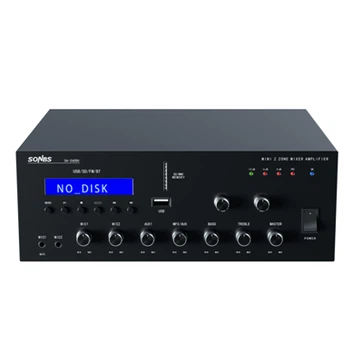
![SA-40DU SA-80DU Karaoke Mixer Amplifier]() SA-40DU SA-80DU Karaoke Mixer AmplifierMINI Mixer Amplifier With USB//FM/Bluetoothread more
SA-40DU SA-80DU Karaoke Mixer AmplifierMINI Mixer Amplifier With USB//FM/Bluetoothread more
SA-40DU SA-80DU -
![SA-1000W SA-1500W SA-2000W Power Amplifier]() SA-1000W SA-1500W SA-2000W Power AmplifierCrafted with a sleek, standard 3U cabinet, this amplifier combines a human-centric design with exquisite craftsmanship for a premium look that complements any professional audio setup.read more
SA-1000W SA-1500W SA-2000W Power AmplifierCrafted with a sleek, standard 3U cabinet, this amplifier combines a human-centric design with exquisite craftsmanship for a premium look that complements any professional audio setup.read more -
![SA-2200 SA-2300 Stereo Amplifier Home Amplifier]() SA-2200 SA-2300 Stereo Amplifier Home AmplifierIt is Muti-source stereo audio amplifier, 4-8Ohm output, it can connect to 4-16Ohm speaker, suitable for home usage, church, coffee shop, restaurant etc.read more
SA-2200 SA-2300 Stereo Amplifier Home AmplifierIt is Muti-source stereo audio amplifier, 4-8Ohm output, it can connect to 4-16Ohm speaker, suitable for home usage, church, coffee shop, restaurant etc.read more -
![SA-480 SA-4120 SA-4250 Stereo Amplifier]() SA-480 SA-4120 SA-4250 Stereo AmplifierIt is Muti-source stereo audio amplifier, 4 Channel 4-8Ohm output, it can connect to 4-16Ohm speaker, suitable for home usage, church, coffee shop, restaurant etc.read more
SA-480 SA-4120 SA-4250 Stereo AmplifierIt is Muti-source stereo audio amplifier, 4 Channel 4-8Ohm output, it can connect to 4-16Ohm speaker, suitable for home usage, church, coffee shop, restaurant etc.read more -
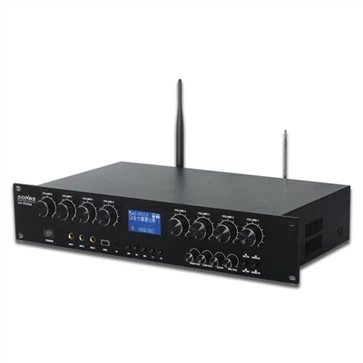
![SA-260DU SA-2120DU SA-2180DU Mixer Amplifier Professional]() SA-260DU SA-2120DU SA-2180DU Mixer Amplifier Professional2-Zones Mixer Amplifier With USB/SD/FM/Bluetoothread more
SA-260DU SA-2120DU SA-2180DU Mixer Amplifier Professional2-Zones Mixer Amplifier With USB/SD/FM/Bluetoothread more
SA-260DU SA-2120DU SA-2180DU -
![SA-30DU SA-60DU Mini Mixer Amplifier]() SA-30DU SA-60DU Mini Mixer AmplifierMINI Mixer Amplifier With USB//FM/Bluetoothread more
SA-30DU SA-60DU Mini Mixer AmplifierMINI Mixer Amplifier With USB//FM/Bluetoothread more
SA-30DU SA-60DU -
![SA-4S60 SA-4S120 SA-4S180 SA-4S240 Professional Sound Amplifier]() SA-4S60 SA-4S120 SA-4S180 SA-4S240 Professional Sound Amp...SA-4S60/SA-4S120/SA-4S180/SA-4S240read more
SA-4S60 SA-4S120 SA-4S180 SA-4S240 Professional Sound Amp...SA-4S60/SA-4S120/SA-4S180/SA-4S240read more
Four-channel Power Amplifier -
![SA-2S60 SA-2S120 SA-2S240 SA-2S360 2 Channel Amplifier]() SA-2S60 SA-2S120 SA-2S240 SA-2S360 2 Channel AmplifierSA-2S60/SA-2S120/SA-2S240/SA-2S360read more
SA-2S60 SA-2S120 SA-2S240 SA-2S360 2 Channel AmplifierSA-2S60/SA-2S120/SA-2S240/SA-2S360read more
Two-channel Power Amplifier -
![SA-240W SA-360W SA-500W SA-650W Amplifier Audio Professional]() SA-240W SA-360W SA-500W SA-650W Amplifier Audio ProfessionalSA-240W/SA-360W/SA-500W/SA-650W Power Amplifierread more
SA-240W SA-360W SA-500W SA-650W Amplifier Audio ProfessionalSA-240W/SA-360W/SA-500W/SA-650W Power Amplifierread more -
![SA-1011 Amplifier for Mosque Sound System]()
-
![SA-850M Receivers Amplifiers Power Amplifier]()
-
![SA-650M Power Amplifiers Professional Amplifier]()





Why Choose Us
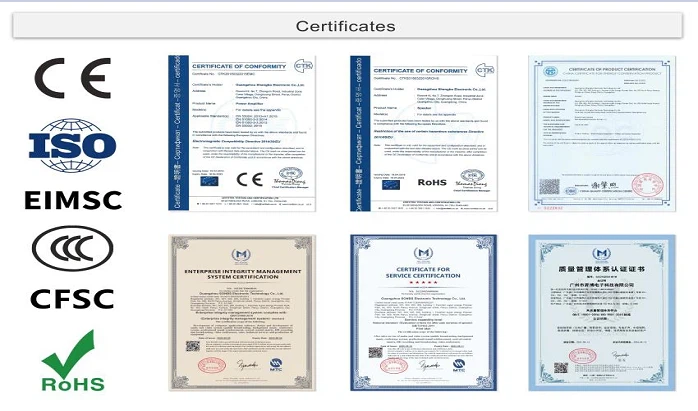
Our Certificate
ISO, CE, ROHS, EIMSC, CCC, CFSC.
Factory strength
SONBS Owns 3 Factories, 1 Marketing Technology Service Center And Over 15 Sub-Office.
Professional Team
Our professional engineer team will help partners to make turn-key solution for projects, improve solution until the customer is satisfied, and answer all technical questions.
Provide technical training
Our professional engineer team can offer technical training and guide the customer to install equipment, for big project, we can send engineer on site to guide the installation.
What is PA Amplifier
PA Amplifier is an electronic amplifier designed to increase the magnitude of power of a given input signal. The power of the input signal is increased to a level high enough to drive loads of output devices like speakers, headphones, RF transmitters etc. Unlike voltage/current amplifiers, a power amplifier is designed to drive loads directly and is used as a final block in an amplifier chain.The input signal to a power amplifier needs to be above a certain threshold. So, instead of directly passing the raw audio/RF signal to the power amplifier, it is first pre-amplified using current/voltage amplifiers and is sent as input to the power amp after making necessary modifications. You can observe the block diagram of an audio amplifier and the usage of power amplifier below.
Benefits of PA Amplifier
Better Sound Quality
Adding an amplifier can improve your sound by acting as a power supply for your speakers, allowing them to be driven without being strained. The built-in amplifier in a factory radio can't compete with the sound quality of a separate aftermarket amplifier.
Volume
A loud motor, a noisy air conditioner, and traffic are all noises that your stereo can't always compete with. An amplifier will help you hear your music by increasing the loudness.
Power for Speakers and a Subwoofer
An amplifier can supply the necessary power for higher-quality aftermarket speakers to work at their best. Subwoofers demand far more power than standard speakers, therefore installing a subwoofer may necessitate the use of a separate amplifier.
Types of PA Amplifier
Class A Amplifier Classes
Class A Amplifiers are the most common type of amplifier topology as they use just one output switching transistor (Bipolar, FET, IGBT, etc) within their amplifier design. This single output transistor is biased around the Q-point within the middle of its load line and so is never driven into its cut-off or saturation regions thus allowing it to conduct current over the full 360 degrees of the input cycle. Then the output transistor of a class-A topology never turns “OFF” which is one of its main disadvantages.
Class AB Amplifier Classes
As its name suggests, the Class AB Amplifier is a combination of the “Class A” and the “Class B” type amplifiers we have looked at above. The AB classification of amplifier is currently one of the most common used types of audio power amplifier design.The class AB amplifier is a variation of a class B amplifier as described above, except that both devices are allowed to conduct at the same time around the waveforms crossover point eliminating the crossover distortion problems of the previous class B amplifier.
Class B Amplifier Classes
Class B amplifiers were invented as a solution to the efficiency and heating problems associated with the previous class A amplifier. The basic class B amplifier uses two complimentary transistors either bipolar of FET for each half of the waveform with its output stage configured in a “push-pull” type arrangement, so that each transistor device amplifies only half of the output waveform.
Class C Amplifier Classes
The Class C Amplifier design has the greatest efficiency but the poorest linearity of the classes of amplifiers mentioned here. The previous classes, A, B and AB are considered linear amplifiers, as the output signals amplitude and phase are linearly related to the input signals amplitude and phase.However, the class C amplifier is heavily biased so that the output current is zero for more than one half of an input sinusoidal signal cycle with the transistor idling at its cut-off point. In other words, the conduction angle for the transistor is significantly less than 180 degrees, and is generally around the 90 degrees area.
Application Of PA Amplifier




Consumer electronics field: Audio amplifier is one of the important components of multimedia products and is used to improve the sound quality of audio systems, TVs, radios and other equipment.
Sound system: In a sound system, the audio amplifier is responsible for amplifying the signal to drive the speakers to produce sound.
Recording equipment: Audio amplifiers are used to enhance audio signals for easier recording and post-processing.
Stage performance: In performance situations, audio amplifiers are used to amplify music or voice signals to ensure that the audience can hear them clearly.
Home audio: Civilian-grade audio amplifiers are widely used in home audio, computer audio and other equipment to provide high-quality sound output.
Portable devices: With the popularity of Class D power amplifiers, audio amplifiers are increasingly used in MP3, PDAs, mobile phones, laptops and other devices.
Wireless communication: In wireless communication systems, audio amplifiers can enhance the transmitted or received signals and improve the transmission distance and receiving sensitivity of the system.
Loudspeakers
These are the main sound-producing component of a PA system, and their sounds are the combined work of amplifiers, equalizers, and mixers. Depending on their power source, speakers are either active or passive. Active speakers have their outlets and plugs. Passive speakers rely on power from a mixer or amplifier.
Power Amplifiers
Power amps amplify the sound you produce and send it to the speakers so that your audience can hear you. Some power amps are built into speakers or the mixing console, but there are also stand-alone options.If you perform in huge venues, you should get stand-alone amps for your PA system. But for smaller gigs, built-in amplifiers are more convenient to bring along.
Mixer
The mixing console allows multiple instruments or inputs to be connected to your PA system. The most basic mixers enable you to amplify and control the volume of each device or input connected to it. More advanced mixers today offer more capabilities.Some mixers allow you to use them as a basic equalizer for individual inputs or the entire group of inputs connected to it. Some mixers allow the output level of monitors and speakers to be controlled independently of each other.
Equalizer and Other Rack Effects
The equalizer is an essential component in a PA system. It is used to tweak or customize sounds according to the requirement of a music venue. It can fine-tune the overall tone of a PA system using different kinds of rack effects. It is also critically used to make last-minute modifications to fix feedback problems and accurately reach the right frequency needed.
Monitors
Monitors are speakers that are always placed in front of the performers, facing them. This allows them to hear their voices and make adjustments when necessary.
Inputs
Inputs are components that produce the sound you make. A microphone is an essential input in a PA system. Instruments are also considered inputs.
How to Choose PA Amplifier
Power output
Power output is roughly equivalent to how loud you can pump out music. The bigger the speakers or room, generally the more power you want (much to your neighbors and housemates dismay!) However, you probably don't need as much power as you'd expect. Generally, 10W is pretty loud for average listening and 100W is enough to blow the roof off most parties!
THD+N
Total Harmonic Distortion + Noise (THD + N) is a measure of just how much effect the amplifier has on the sound output. More distortion generally means more colouration to the sound. The lower this figure, the closer the output of the amplifier will sound to the original recording. Of course, speakers will have the biggest effect on sound, so choose some that are well matched to your listening preference.
SNR (Signal to Noise Ratio)
If you stand in a quiet room, in the countryside, away from the hustle and bustle, you might notice noises you've never noticed before. The humming of a radiator or cars travelling down a nearby road for example. None of this is apparent when the kids are home with the TV blasting away, but that background noise is still there. An amplifier is the same, there is always a very small amount of noise from the electrons whizzing around inside. The goal is to make this background noise imperceptible, this means you hear more of the music and less of the noise. The measure of this is the signal to noise ratio.
Crosstalk
Left is Left, Right is Right and Crosstalk is a measure of how much undesirable left signal is mixed with right output. Amplifiers all being one box are doing their best to be separate boxes one per channel, splitting apart the signals to ensure when it reaches the speakers, you can tell that the singer is standing slightly to the left of the stage and the violins towards the right. The more crosstalk there is, the harder it is to pick out the positions of the instruments as stereo separation is affected.
How PA Amplifiers Improve Audio Quality?

Clarity
A good PA amplifier will ensure that the sound is clear and intelligible, even in noisy environments. This is achieved through equalization and filtering functions, which can help to remove unwanted frequencies or boost specific frequency ranges.

Dynamic range
PA amplifiers can help to preserve the dynamic range of the audio signal, ensuring that quiet passages are still audible while louder sections remain clear and distortion-free. This is achieved through compression and limiting functions, which can help to control the peaks and valleys in the audio signal.

Sound distribution
PA amplifiers ensure that sound is distributed evenly across the listening area. This is achieved through the use of multiple speakers and by adjusting the levels and timing of each speaker to create a uniform sound field.

Speaker protection
PA amplifiers also provide protection for the speakers by limiting the amount of power sent to them. This prevents the speakers from being overloaded and damaged, ensuring that they last longer and provide consistent sound quality.
How to Maintain PA Amplifier
Keep it clean
Dirt, dust, and other debris can accumulate on an PA Amplifier exterior, which can obstruct ventilation and cause overheating. Overheating can damage components, so it's essential to regularly clean your PA Amplifier to ensure that it operates efficiently and stays cool. Pay special attention to vent grilles.To clean your amp, use a soft, dry cloth to wipe down the exterior. You can also use a vacuum cleaner with a soft brush attachment to remove dirt and dust from the ventilation grilles and other hard-to-reach areas. While you're at it, use a dust cover when it's not in use, and for Pete's sake, keep it dry. No drinks allowed!
Ventilate it
Since PA Amplifier generate heat as they operate, proper ventilation is crucial to prevent overheating. So, in addition to keeping the case dust free, make sure your PA Amplifier is placed in a well-ventilated area, away from other electronic devices that generate heat. If necessary, use an extra fan to add airflow and if possible, keep the amp in a cool area – but not freezing. Extreme temperatures and PA Amplifier aren't friends.
Transport it carefully
This should go without saying, but even a rugged guitar cabinet needs care when handling. Don't just toss your amp around when you get to the gig, or you could find yourself with loose internal connections, busted tubes (or feet), and possibly no sound for the show.
Turn down the volume
We're talking mainly about power up here. Before you power up an amp, turn it down to avoid damaging spikes. In addition, make sure you're powering gear up in the right sequence.
Check and replace tubes
Tubes are a critical component of vacuum tube amplifiers, and they require regular maintenance to function optimally. Over time, tubes can wear out, leading to reduced sound quality or even complete failure. To ensure your tubes are in working order, inspect them regularly for signs of wear and tear. If you notice any cracks or discoloration, it may be time to replace them. Best to replace all the tubes in the amplifier at the same time to maintain sound consistency.
Use proper cables and connectors
Using the wrong cables or connectors can cause noise and interference, which can degrade sound quality. Therefore, it's essential to use high-quality cables and connectors that are compatible with your amplifier. Finally, make sure cables are properly connected with no loose connections. After all, shoddy connections are noisy.
Our Factory
SONBS owns 3 factories, 1 marketing technology service center and over 15 sub-office ,covering a total area of more than 50,000 square meters. We have 50 R&D engineers, 100 pre-sales and after-sales technicians, 250 sales and 200 assembling workers, all totally about 600 employees.


certificate

FAQ
As one of the most professional pa amplifier manufacturers in China, we're featured by quality products and good service. Please rest assured to buy customized pa amplifier at competitive price from our factory.